
Car Alignments Versus Tire Balancing: What Do You Need?
Navigating the world of automotive maintenance can sometimes feel like trying to decipher a foreign language, especially when you are faced with similar-sounding services. Two of the most frequently confused maintenance procedures are car alignments and having your tires balanced. While both are critical for maintaining a smooth ride and extending the life of your rubber, they address entirely different issues within your vehicle's mechanics. Knowing the differences between these two procedures ensures you can describe your vehicle's symptoms and request the care your vehicle needs.
Many drivers notice a subtle change in how their vehicle handles and immediately assume they need a single, catch-all fix. However, your steering system and your wheel assemblies operate on different mechanical principles. Misunderstanding these differences can lead to ignoring a growing problem or spending money on the wrong vehicle service. By breaking down exactly what happens during each service, you can become an informed driver who takes proactive care of your automobile.
Understanding the Mechanics of Car Alignments
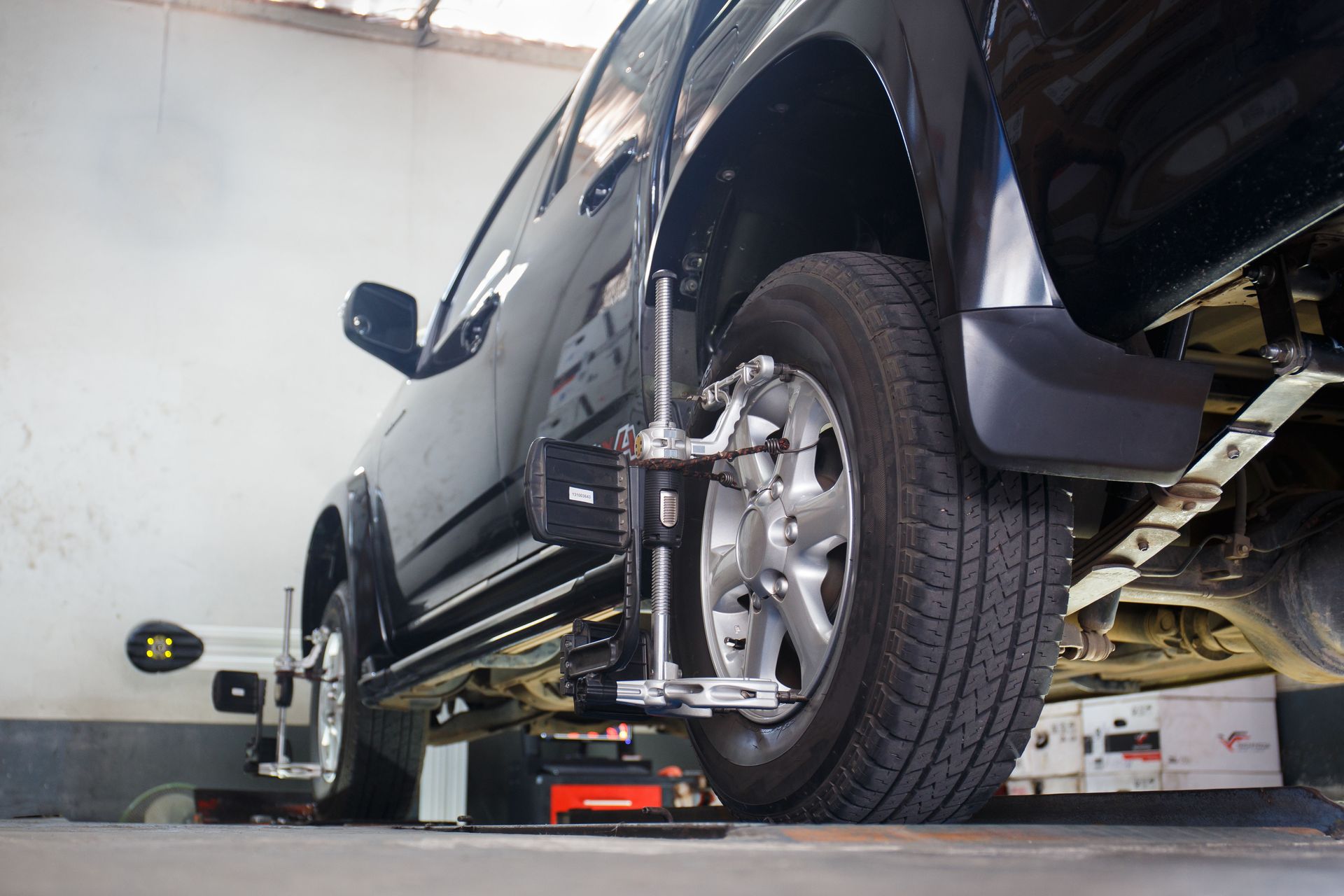
When technicians perform car alignments, they are not actually making adjustments to your tires or your wheels directly. Instead, this specific service focuses entirely on adjusting your vehicle suspension system, which is the intricate network of springs, shocks, and linkages that connects the vehicle to its wheels. Over time, hitting potholes, bumping against curbs, or simply driving on rough surfaces can knock these suspension components out of their precise factory settings, causing your wheels to point in slightly different directions.
During car alignments, a technician will carefully measure and adjust the angles of the suspension components to ensure that the tires make contact with the road at the proper angle. This process centers your steering wheel and ensures that the vehicle travels in a perfectly straight line when you let go of the wheel. Without this critical adjustment, your steering components experience undue strain, and your vehicle will constantly fight against your steering inputs, making your daily commute much more tiring and potentially hazardous.
Recognizing the Signs of Poor Car Alignment
Identifying when vehicles require car alignments is usually a matter of paying close attention to how the steering wheel feels in your hands. The most common red flag is a distinct pulling sensation, where the vehicle drifts toward the left or the right side of the road even when you are trying to drive straight. You might also notice that your steering wheel sits at an awkward, crooked angle even when your vehicle is moving forward in a perfectly straight path.
The steering wheel might also feel loose, or you could notice a delayed response when you attempt to make a turn. According to Yahoo Finance, an alignment could be in order if one tire looks balder than the others, or an individual tire is wearing asymmetrically. Paying attention to these visual and physical cues early can save you from experiencing severe handling difficulties down the road, ensuring that your vehicle remains predictable and responsive during sudden maneuvers or inclement weather.
Understanding the Process of Tire Balancing
While car alignments correct the suspension angles, tire balancing corrects the distribution of weight within the wheel and tire assemblies themselves. Tires are manufactured with slight imperfections, meaning that one side of a tire might naturally be a fraction of an ounce heavier than the opposite side. When these wheels spin at high speeds on the highway, even a tiny weight imbalance creates a heavy amount of centrifugal force, which causes the entire assembly to hop or wobble violently.
To fix this issue, a technician places the wheel assembly on a specialized balancing machine that spins the tire at high speeds to detect exactly where the weight distribution is uneven. The technician then attaches small, precise metal weights to the outer or inner rim of the wheel to counteract those heavy spots. This process ensures that the tire spins completely smoothly, distributing the weight evenly across the entire circumference of the wheel and preventing the chaotic forces that lead to a bumpy ride.
Recognizing the Signs of Imbalanced Tires
The symptoms of imbalanced tires are distinctly different from the symptoms that indicate you need a car alignment. Instead of a physical pull to one side of the road, an imbalance manifests as a rhythmic vibration or shaking sensation that becomes progressively worse as your vehicle gains speed. You will usually begin to feel this shaking when you transition from city streets to the highway, and the vibration can fluctuate depending on how fast you are traveling.
Where you feel the vibration can also tell you which set of wheels is causing the issue. If you feel the shaking primarily in your steering wheel, the imbalanced tires are likely located on your front axle. If you feel the vibration mostly in your seat or across the floorboards of the vehicle, the problematic wheels are typically located on the rear axle. Ignoring these vibrations can cause premature wear on your shocks, struts, and wheel bearings, leading to expensive mechanical failures.
Comparing the Structural Benefits of Each Service
Choosing between car alignments and tire balancing requires looking at the structural benefits each service provides to your vehicle chassis. Proper suspension alignment protects your steering linkage, preserves your steering gearbox, and ensures that your vehicle's safety features, like electronic stability control, function correctly. It keeps the structural geometry of your vehicle intact, ensuring that the impact from bumps in the road is distributed evenly across the entire suspension system rather than punishing a single component.
Balancing your tires, on the other hand, protects the localized mechanical components surrounding the wheel well. It prevents the constant, high-frequency hammering action that an imbalanced wheel inflicts upon your wheel bearings, brake assemblies, and suspension joints. By keeping the wheel spinning smoothly, you eliminate the violent vibrations that can gradually loosen fasteners and cause components to fatigue early, ensuring that your daily drives remain quiet and smooth.
Evaluating the Economic Impact on Tire Longevity
Both maintenance services play an indispensable role in protecting your financial investment in a set of tires, but they prevent different types of monetary loss. Neglecting needed car alignments leads to rapid, localized tread wear that can destroy a brand-new tire in a matter of months. This uneven wear typically appears on the inner or outer edges of the tread pattern, scraping the rubber away down to the internal cords while the rest of the tread remains perfectly intact.
Failing to balance your tires creates a completely different pattern of destruction known as cupping or scalloping. This condition appears as a series of bald spots or wavy dips around the circumference of the tread, caused by the tire continuously bouncing up and down against the pavement as it rolls. Both issues force you to purchase replacement tires much earlier than expected, but maintaining proper service schedules keeps your tread wearing evenly, allowing you to maximize the lifespan of your rubber.
Keeping your vehicle in peak operating condition requires recognizing that
car alignments and tire balancing are complementary services. Whenever you invest in a new set of tires, experience a harsh impact with a pothole, or notice unusual vibrations and steering behavior, scheduling a professional inspection is the best course of action. If you are experiencing any handling issues or unusual tire wear, contact LexService located in Harbor City, CA today to learn more about our comprehensive vehicle care and how we can restore your smooth ride.









Share On: